Study hacks for competitive exams that ensure sure-shot success.
If you are preparing for
JEE Main, JEE Advanced, CAT, NEET or any other competitive exam, you have to follow a disciplined routine while making a whole lot of time to relax.
Stress can
really drag your spirits down if you start preparing at the last minute. So
here are some study skills that can ensure sure-shot success!
Take control of your mind.

If you study the same subject at the same time and the same
place, your brain makes the association and gets trained accordingly. Over a
period of time you will automatically get in the mood to study the subject
within 10 minutes if you just make it a habit.
It works even when you hate a subject! You can trick yourself
into doing what you don’t want to do :)
Remember to revise.

Just scan through the topic you learnt that day at least once
after you get back home. It helps you memorise things that you may think you
will never forget but probably will!
Take it easy

Don’t sit down and try to cram all the material into your head all
at once. Have many short study sessions and a few long breaks!
Consider this: When
you study for a limited time, it makes your brain work more
efficiently. Most of the IITians report that they can cram much more a day
before an exam than a regular day – which just confirms this particular
research conclusion. Besides, it is believed that during study breaks, the mind
absorbs information automatically, without any conscious effort on your
part. Hence, for intense memorization sessions like when you are trying to
learn dates and events, names of countries and their capitals, a foreign
language or math formulae, you should not study for more than 20 to 30 minutes
at a stretch.
Don’t try to study when you’re sleepy L

Sitting with books when sleepy-eyed is a total waste of time. If
you have too much backlog to cover, just do something light at the time – like
clearing your desk, sorting your notes or arranging your school bag to let the
sleepy phase pass. Better idea? Take a quick 15-minute nap to charge your mind
for your study time.
Working smart is just as important as working
hard.

The attention you pay to
the subject and alertness of your mind matters more than the time you spend on
it. For competitive entrance examinations, especially, one does not count the
number of hours he/she is spending in front of books; Rather, you need to
measure the amount of focused study you’re doing. Most common strategies to
keep yourself alert are:
Minimise distractions.

·
Start with the most
difficult or boring subject when you are fully alert.
·
Keep the easier ones
for the times when you feel lazy to study.
Mix it up!

Do not schedule similar subjects one after another. Please don’t
mix math with scientific equations all in one moment! Try something else on the
far end of the spectrum to refresh your mind.
OK4R
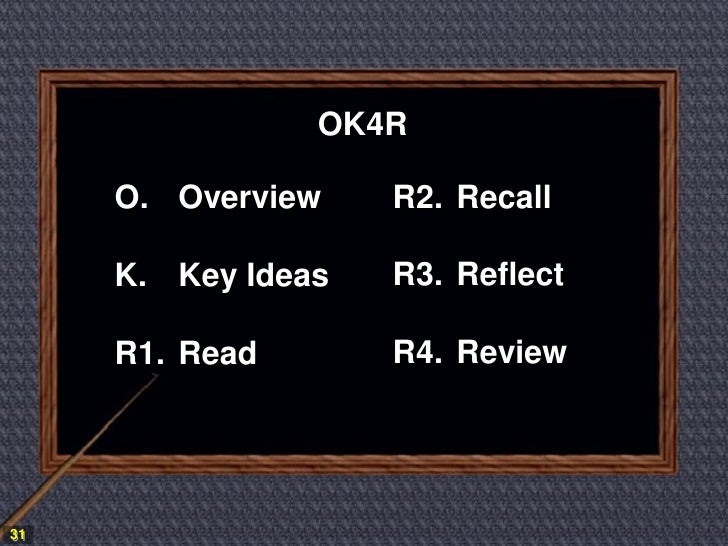
Dr. Walter Pauk has devised the OK4R method,
which can help you pack more information through power reading. It is to
help you to ace competitive entrance exams. Here is how you go about it:
·
O for Overview: In the
first glance, just read the headings, sub-headings, introductory paragraph, and
summary at the end of the chapter. It will give you a general idea of what is
included in the chapter.
·
K for Key ideas: Now,
go back to the beginning of the chapter and try to skim through the key ideas.
The first sentence of each paragraph, italics and bold-type text, tables,
pictures and diagrams, bulleted sections and itemizations often present key ideas
of the chapter.
·
R1 for Reading the
topic or chapter from beginning to end: Now that you already know what is being
discussed, read through the entire chapter and see a full explanation of the
ideas.
·
R2 for Recall: Now put
your book aside and write down major points of what you have read and make your
notes in few words or sentences. The immediate recall will only take a minute
or two but doubles up retention time of the topic you are studying.
·
R3 for Reflect: Now
that you have kept the material in the storage unit of your memory it, sift it
to put it in your permanent memory. Think about it and try to find the
significance of what you have read and its relationship with other topics you
have learnt.
·
R4 for Review or
Revision: On weekends, you can test yourself on what you have learned
throughout the week. In schools, there can be tests and quizzes that help you
go through your notes again. These time-to-time reviews or revisions help you
fix the information forever.
Keep your mind at ease - The most important thing!

Relax and take breaks during your hectic study
timetable. Use this time to rejuvenate yourself, watch a movie, listen to some
songs, or play a sport. It will help you stay focused and feel fresh.


Comments
Post a Comment